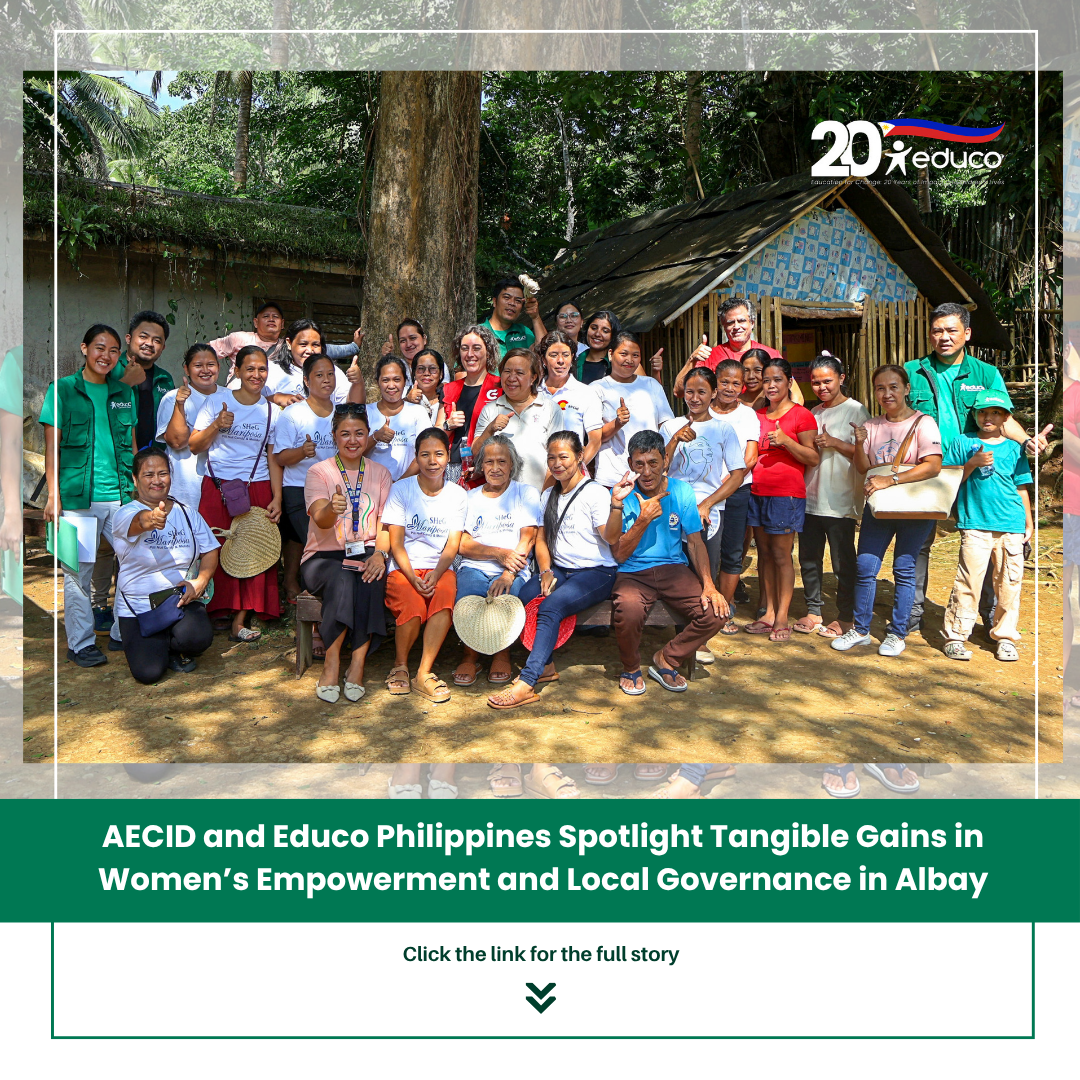
The Agencia Española de Cooperación Internacional para el Desarrollo or Spanish Agency for International Development Cooperation (AECID) recently visited project sites in Albay to assess the outcomes of Project WE-LEAP (Women Empowerment on Leadership in Economic Resource Access and Participation through Gender Responsive Protection and Governance Mechanism in Albay, Philippines) a collaborative initiative with Educo Philippines focused on advancing women’s leadership, economic participation, and protection mechanisms through gender-responsive, community-based governance.
Headed by Natalia Zapata (AECID Madrid), Violeta Dominguez Acosta (Director, AECID Manila), and Project Managers Laura Antelo and Francisco Quesada, the AECID team engaged directly with local leaders and women’s groups who are at the heart of the project’s success together with the leaders of Educo Philippines.
Transformative reach across Albay
Implemented in the municipalities of Camalig and Manito in Albay, the project spans 30 barangays and has directly benefited 3,944 individuals including 3,000 women and 944 men, with an additional 3,600 indirect beneficiaries, primarily children and family members. The initiative has surpassed its targets, achieving 122% of its goal for women beneficiaries and 120% for men.
A total of 103 duty bearers have also been empowered through targeted capacity-building activities, strengthening their roles in promoting gender equality, child protection, and inclusive local governance. This focus on institutional support ensures that the gains achieved at the community level are reinforced by formal governance structures.
Women’s economic empowerment through self-help groups
A central component of Project WE-LEAP is the promotion of women-led Self-Help Groups (SHeGs) as vehicles for economic empowerment and community leadership. To date, 65 community SHeGs have been established or strengthened, with 60 trained community facilitators supporting their development and sustainability.
Through these groups, women have launched 30 community enterprises focused on livelihood activities such as broom production, local delicacies made from pili and cassava, and abaca weaving. They have collectively prepared 47 business plans, signaling both entrepreneurial readiness and a pathway to sustainable income generation.
The project also facilitated the development of Gender and Development (GAD) Plans across all 30 barangays, while supporting the creation of a provincial-level reporting and referral pathway for gender-based violence, contributing to both prevention and response systems at scale.
Strengthening women’s leadership and protection systems
Project WE-LEAP has placed a strong emphasis on organizing women into formal structures that amplify their voices and leadership. These include the Federation of Project WE-LEAP Women Self-Help Groups in Manito and the Self-Help Group Women’s Agricultural Cooperative in Camalig, both of which serve as models of collective economic and social action.
The project also contributed to the establishment of gender violence prevention officers and increased community awareness of protection mechanisms, enhancing both safety and accountability within barangays.
Sustaining and scaling the impact
The visit underscored how strategic donor investment grounded in rights-based, gender-responsive approaches can produce lasting and measurable change. Through close coordination with local government units and continuous support to grassroots organizations, AECID and Educo Philippines have laid the groundwork for sustainable development outcomes that can be scaled and replicated across other vulnerable communities.
Project WE-LEAP demonstrates that with the right support structures, women in rural communities can become leaders in economic development, protection systems, and local governance, empowering not just themselves, but entire communities.